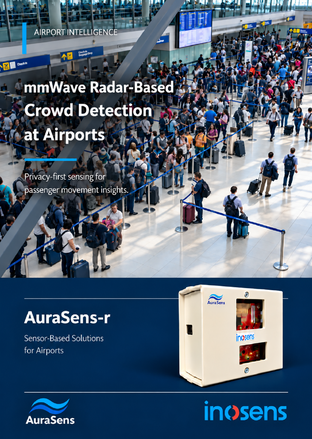
AuraSens-r: mmWave radar based human activity detection
- Project
- 22006 SINTRA
- Type
- New product
- Description
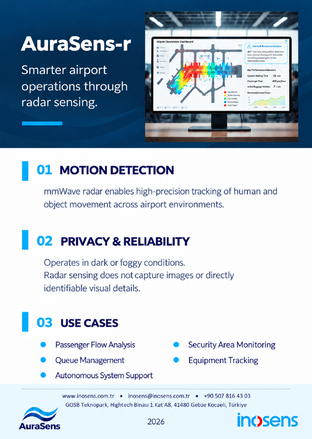
INOSENS defined a product trademark for the output of this project which is called AuraSens-r (Radar). Product definitions and brochures are completed and listed in company web site (https://inosens.com.tr/aurasens/). AuraSens-r is a people detection and tracking system for airport terminals based on 77 GHz mmWave radar (TI IWR1843). It is designed for areas where cameras are not acceptable: the sensor produces no images, and the system outputs only an anonymous track ID, position and timestamp per person. Developed in SINTRA UC1, the software processes the radar point cloud at 10 Hz on an edge PC. It combines range-adaptive, Doppler-weighted DBSCAN clustering, Kalman filter and Hungarian multi-object tracking with a track verification lifecycle, empty-room background calibration and suppression of multipath ghost targets. Two radars can be fused in an L-shaped layout to cover blind spots of a single sensor. Tracks are streamed live over secure WebSocket (WSS) to the TAV Technologies AOCC platform. A web dashboard shows people count, trajectories, a density heatmap, automatically detected queues, waiting time and congestion.The method was published at IEEE SIU 2026 together with TAV Technologies and Gebze Technical University.
- Contact
- Gökçe Keskin
- gokce.keskin@inosens.com.tr
- Research area(s)
- Sensors / IoT, Artificial Intelligence / Data analytics, Safety & Security, Smart mobility / Transport
- Technical features
- Sensor: TI IWR1843BOOST, 77-81 GHz FMCW mmWave radar; 3D point cloud with Doppler velocity and SNR per point.
- Processing rate: 10 Hz, on an edge PC (no cloud processing).
- Detection: range-adaptive DBSCAN clustering with Doppler weighting; merging of body-part clusters and splitting of merged people in crowds; human-size candidate filter.
- Tracking: constant-velocity Kalman filter with real time step, Mahalanobis gating and Hungarian assignment; track lifecycle (tentative, confirmed, verified) so that only verified tracks receive a public ID.
- Indoor robustness: empty-room background map (30 s calibration), rule-based and self-learning suppression of multipath ghost targets, holding of standing people, re-identification after short loss, warning when a sensor has been moved.
- Multi-sensor: early fusion of two radars in an L-shaped layout (software is independent of the number of sensors).
- Analytics dashboard (web): live people count, trajectories, density heatmap, automatic queue detection, queue position and waiting time, congestion detection; also accepts LiDAR tracks.
- Practical range (measured indoors with one radar): walking person up to approx. 5-6 m; standing person up to approx. 3 m.
- Integration constraints
- Edge PC: Ubuntu 18.04 with ROS Melodic and Python 3; radar connected over USB (TI XDS110).
- Output interface: JSON over secure WebSocket (WSS); one record per person with the fields Type, ID, Coordinates [x, y, z] and Timestamp; max. 4 Hz.
- Dashboard: runs on the edge PC or any PC on the same network; viewed in a standard web browser (port 8765 must be reachable).
- Installation: radar mounted at a fixed position facing the monitored area; sensor positions entered in a configuration file; 30 s empty-room calibration after installation or any change of the scene.
- Several radars: sensors in the same frequency band can interfere; band splitting is available as an experimental option, hardware synchronisation is not yet supported.
- Coverage: single-chip radars suit entrances, queues and bottlenecks; large open areas need several sensors or long-range (4D imaging) radars.
- Targeted customer(s)
- Airport operators and airport IT / operations-platform providers (AOCC, passenger flow and queue management).
- Other transport hubs: railway and metro stations, ports and terminals.
- Indoor public spaces where cameras are restricted: retail, public buildings, smart buildings (occupancy and flow).
- Conditions for reuse
Commercial license for INOSENS.
- Confidentiality
- Public
- Publication date
- 09-11-2026
- Involved partners
- TAV Technologies (TUR)
- inosens (TUR)