

SmartEM turns engineering models into practical solutions for smarter manufacturing and product development
In CNC-based manufacturing - where computer-controlled machine tools automate processes following pre-programmed instructions instead of manual operation - time lost to setup, loading and unloading can significantly affect productivity, particularly in small production runs. SmartEM partners ACD, Alpata Technology and INOVASYON are addressing this challenge by developing an integrated approach combining machine-learning surrogate models, production data and key process parameters. By integrating ACD’s web platform with INOVASYON’s digital twin and AI-based surrogate modelling, the partners demonstrate how connected models and production information can support more efficient machine operation and near-real-time evaluation of production scenarios.
In this video, you can see how Digital Twins, AI and surrogates help reduce machine downtime:

From demonstrations to reusable engineering knowledge
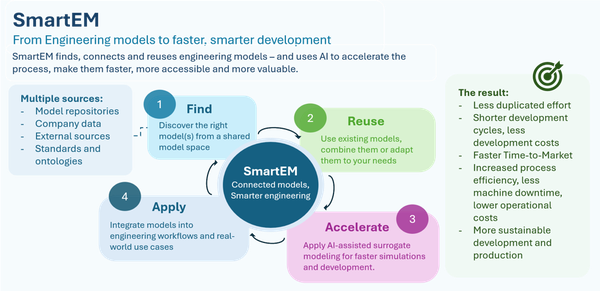
Engineering models are digital representations of products, systems or processes that help engineers design, test and improve them before they are built or put into use. This example illustrates the broader ambition of the ITEA project SmartEM: making engineering models easier to connect, reuse and apply across development and production processes.
The models are essential to modern product development and manufacturing, but creating, adapting and connecting them across tools and domains can be time consuming. SmartEM aims to make this process easier by enabling models to be reused, shared and connected, with results emerging across AI-assisted surrogate modelling, model stores, digital twins and reference architecture.
One example is the use of AI-assisted surrogate models for high-fidelity hair-shaving simulations. Eindhoven University of Technology and Philips Consumer Lifestyle evaluated several machine-learning approaches and found that high accuracy on new datasets or simulation settings can require retraining. This has led to a focus on more generalisable pretrained surrogate models that could improve transferability while reducing retraining effort. The work contributes to the broader AI-enhanced surrogate-modelling activities involving Siemens, CPP, TU/e, Philips, Reden and KU Leuven.
SmartEM has also made progress in developing practical solutions that make it easier to store, manage and use engineering models. Alpata Technology and Philips have developed web-based tools that help engineers organise models and use them in their daily work. Canon has explored ways to automatically connect different models using information about their content and purpose. Several practical examples have also shown how models can be tested and reused within existing engineering tools and processes, saving time and reducing the need to start from scratch.
Connecting models through digital twins
Digital twins provide another way of bringing engineering models together. Thermo Fisher Scientific has integrated models for Transmission Electron Microscopes covering image detectors, workflow throughput, stage and specimen behaviour, and optics. The resulting digital-twin environment provides a foundation for testing, performance prediction, diagnostics, maintenance and training. By connecting models describing different aspects of a complex system, it demonstrates how engineering knowledge can support decisions throughout the system lifecycle.
These use cases are underpinned by the first version of the SmartEM Open Reference Architecture, led by TNO-ESI and structured across six RADIST layers. The project has also developed a structured approach that helps engineers translate complex questions into the technical steps and solutions needed to address them. This provides a useful foundation for developing future systems using engineering models.
From project results to exploitable solutions
SmartEM is also translating its work into concrete outputs. An Ontology-Based Indexing and Retrieval System developed by SemLab and Reden uses structured metadata and AI-assisted processes to make engineering models easier to discover, understand and reuse. Next to this, an Automated Scoring Model Documentation Parser was developed by SemLab, Reden and Eindhoven University of Technology.
Together, these developments demonstrate how SmartEM is moving towards practical tools and methods that can be integrated into engineering workflows, making engineering knowledge easier to discover, reuse and apply - helping organisations build on existing models rather than repeatedly starting from scratch.
More information: https://itea4.org/project/smartem.html