

Resilient AI steps into real-world care
As enterprise operating environments grow more dynamic and complex, strengthening resilience to diverse unforeseen events becomes essential. The ITEA project ResilientEnterprise brings together partners from Finland, Portugal, the UK, and Switzerland to develop innovative, commercially viable, AI-enabled technologies for construction, intelligent built environments, the financial sector and elderly care. From an end-user perspective, the project aims to help organisations create perceptive, safe, and financially viable workplaces.
A good example can be found in the UK, where project partners are bringing resilient AI from the laboratory into real-world hospital care settings.
From the lab to the bedside: bringing resilient AI into UK care homes
Falls, unnoticed deterioration and loneliness are among the biggest challenges in elderly care. In the UK, project partners Swift Robotics and the Open University's Knowledge Media Institute (KMi) are tackling them together, pairing a bedside companion robot with AI that can tell when something in a care or clinical setting isn't right.
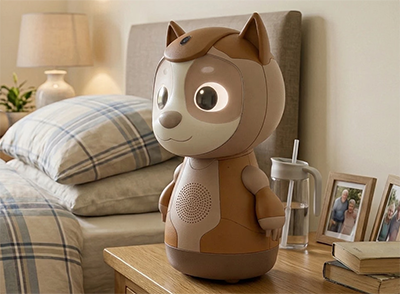
Nova: a companion that keeps watch
SME Swift Robotics has developed Nova, a plug-and-play bedside companion robot for care homes and hospitals. Nova chats with residents, gives medication and hydration reminders, and keeps watch around the clock for falls, collapses and residents getting out of bed unassisted, alerting care staff straight away. All speech and vision processing runs on the robot rather than in the cloud, which matters a great deal to care providers who need to protect residents' privacy. Residents can simply tell Nova to cancel a false alarm, while safety-critical commands follow fixed rules so the robot responds quickly and predictably.
Tested where it matters
The technology has moved out of the lab and into a working UK care home, where it was tested alongside care staff. It performed strongly, and the home's management has fully backed the next phase. Swift Robotics has also demonstrated Nova to several UK care-home groups, securing further trials and pilots.
Watch Nova in action:

Common-sense AI for safer environments
In parallel, the Open University team has built a perception and reasoning framework that helps a robot make sense of clinical environments. It recognises 60 types of hospital objects and reasons about them using a purpose-built ontology, so it can flag blocked exits, spillages, people in the wrong place or unusual patient activity. The framework was validated on real-world data collected by the Open University's HanS robot at a UK hospital. The results show that adding depth sensing and common-sense reasoning makes AI much more reliable outside the lab, which is at the heart of the project's resilient AI theme.
Reaching audiences worldwide
The work is attracting attention well beyond the consortium. Swift Robotics has been featured on ITV News in the UK and on CGTN in China, has exhibited at the Care Show London and the AI+Health Innovation event, and has joined NVIDIA's Inception programme. Internationally, Swift placed third at HICOOL 2026 in Beijing, spoke on a panel at Shanghai 2026 and presented Nova in Brussels at the Optics Valley Youth Entrepreneurship Hub European Session. At home, the Open University presented the project to Milton Keynes City Council and local political leaders at its June 2026 Showcase.
What's next?
Next, the partners plan to turn trials into pilot deployments across UK care-home groups, extend Nova's monitoring to early signs of clinical deterioration, and feed these real-world lessons into the consortium's shared definition of resilient AI.
More information:
Related projects

ResilientEnterprise
Improving Resilience of Enterprise Workforce and AI to Operational Challenges