
Community Talk with Oliver Lenord
A career shaped by collaboration and innovation
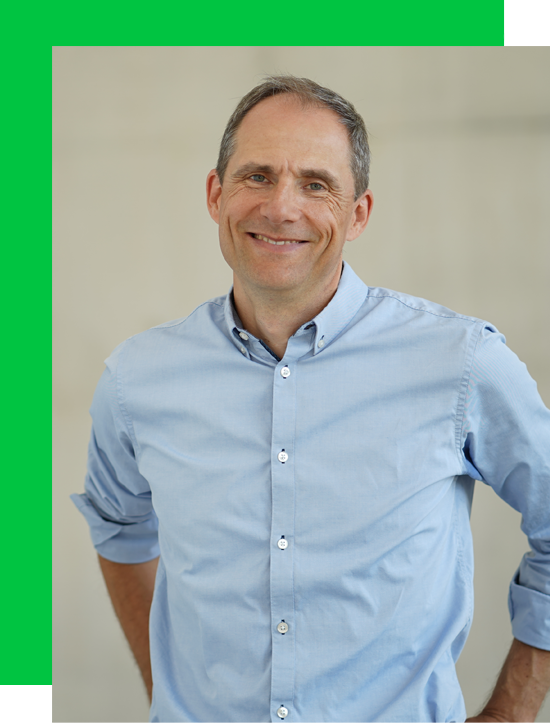
Oliver Lenord’s passion for innovation began in childhood. “I grew up in a household of engineers and entrepreneurs,” Oliver begins. “My father was an electrical engineer who, in 1965, founded a company with three friends in the basement of my grandmother’s house.” Two small rooms and a handful of tables were enough to launch what would become a lasting enterprise. “What impressed me most wasn’t just the technology – it was the mindset: deliver value, keep your word and never compromise on quality.” That spirit shaped him. “There was always this drive to challenge the status quo, to look ahead and to take risks to solve the unsolvable.”
Four-legged robots
Although surrounded by electronics, Oliver followed a different path. “I was fascinated by things in motion, so I chose mechanical engineering.” At the University of Duisburg (Germany), he joined Professor Hiller’s pioneering mechatronics chair and completed a PhD in multi-body system simulation. “Simulation brought everything together: motion, control and 3D visualisation. I loved imitating the real world in a virtual environment, predicting behaviour and validating those predictions.” His research ranged from analysing oscillations in large concrete pump manipulators to simulating four-legged robots inspired by zoological studies. Along the way, hydraulics caught his attention and that brought him to Bosch Rexroth where he joined a young simulation team tasked with building a proprietary simulation platform from scratch. “We had clear objectives but enormous freedom in how to achieve them. That freedom was incredibly motivating.”
Opening the ITEA door
Oliver first became involved in ITEA through the OpenPROD project, where he became national coordinator of the German consortium. The project’s mission – advancing holistic model-based engineering – perfectly matched his experience and the criticality of connecting design modelling with software and control development. A major milestone followed with the Functional Mock-up Interface (FMI). “With FMI, we bridged physical modelling and real-time applications and, crucially, it became an open standard. Unlike internal tools, open standards enable broader adoption and scaling.”
What keeps him engaged is the collaborative ecosystem. “In-house solutions always reach a limit. Within ITEA, you bring together researchers, large industry players and SMEs. Each contributes something unique: deep technical expertise, process knowledge or scalable business models.” Participating in ITEA has enabled Oliver to develop personally. “I grew tremendously,” he says. Coordinating international consortia strengthened his leadership and communication skills. “It’s like juggling several ping-pong balls at once. You must align diverse interests and keep everything moving.”
Shared challenges and unexpected synergies
The cross-industry exposure was equally valuable. “At Bosch, we focus on automotive and industrial applications. Through ITEA, I engaged with experts from aerospace, automation and research institutions across Europe. You discover shared challenges and unexpected synergies.” For his organisation, the benefits have been substantial. “Through ITEA, we advanced standards like FMI and later SSP, enabled large-scale Modelica applications, and influenced future toolchains. Such achievements we couldn’t have realised alone.”
ITEA projects, he explains, balance technological ambition with economic sustainability. “You’re asked the right questions, not only to convince evaluators but to ensure long-term success.” The European dimension is another key strength. “Expertise in Modelica and systems engineering is distributed across countries. ITEA provides the platform to combine those strengths.”
ITEA projects balance technological ambition with economic sustainability
The next big thing
He points to generative AI and large language models. “We’ve bridged design and control modelling and explored physics-enhanced neural Ordinary Differential Equations (ODEs). But transitioning between abstraction levels, from requirements to functional, logical and physical descriptions, remains a challenge.”
Such transitions require creative, generative steps. “There’s no one-to-one mapping. You always need to add context and detail. Generative AI could translate between representations and generate coherent missing pieces.” The real opportunity lies in merging AI with physics-based modelling languages like Modelica. “If AI can produce physically coherent equations grounded in engineering principles, we can elevate model-based systems engineering to a new level.”
Anything to add?
He smiles. “Innovation thrives at intersections – between disciplines, industries and cultures. ITEA creates exactly that intersection. And as long as there are unsolved challenges, I’ll remain curious, and involved.” It’s in his blood.
Discover other Community Talk interviews: https://itea4.org/meet-the-sparks-of-itea.html
Related projects

EMPHYSIS
EMPHYSIS – Embedded systems with physical models in the production code software