
Advancing AI-driven software engineering: Highlights from the GENIUS Austria Convention 2026
As part of the ITEA GENIUS project, the GENIUS Austria Convention 2026 brought together a diverse audience of representatives from industry, academia, and technology leaders as part of a three-day event dedicated to explore the future of AI-based software engineering. Co-organised by project partners CASABLANCA hotelsoftware and the University of Innsbruck, the event focussed on one shared ambition: making generative AI a practical, transformative force across the entire software development lifecycle.
From research vision to practical AI solutions
The programme featured working sessions, expert talks, and innovation dialogues that showcased how generative AI can fundamentally rethink and streamline manual development processes. A special evening event gathered around 60 guests from the fields of politics, business, and science, where international project partners presented their latest tools and research findings:
- British Telecom demonstrated Alfred, an AI-powered voice assistant designed to support software architects in navigating complex design decisions through natural conversation.
- Siemens introduced an LLM-based multi-agent system for requirements engineering, demonstrating how intelligent agents can support the elicitation, generation, and analysis of requirements to streamline early stages of the development process.
- Diffblue presented their work on reliable agents for automated test generation, a significant step towards reducing one of the most time-consuming aspects of software quality assurance.
- Vaadin rounded out the technical presentations with their approach to making their development platform natively compatible with AI coding assistants, enabling agents to understand project structure and deliver context-aware support directly within the developer's workflow.
Together, these presentations showed a clear overview of an ecosystem rapidly shifting towards AI-augmented and agent-driven development, where repetitive tasks are automated, architectural decisions are supported in real time, and software quality is continuously improved with minimal manual intervention.
Award-winning innovation
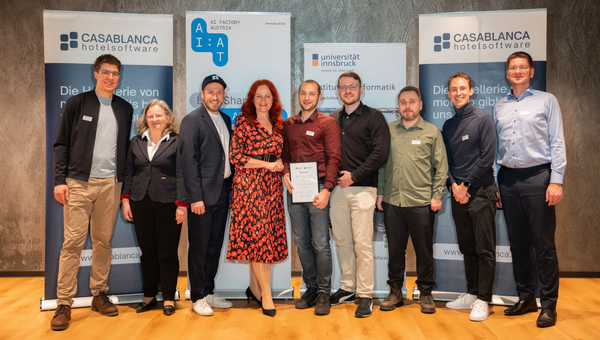
A standout contribution came from Cape of Good Code, whose presentation 'Navigating Complexity: A Data-Driven Roadmap for Architecture Modernization' addressed how to manage and evolve legacy architectures leveraging a combination of AI algorithms and Domain Driven Design principles, a methodology that resonated strongly with both the research and industry audience present. Their work was recognised with the GENIUS research prize following a vote by the convention audience, which included both project partners and external participants. The award was presented by Cornelia Hagele, Member of the Tyrolean Provincial Government responsible for Health, Care, Education, Science and Research, and Univ.-Prof. Dr. Ruth Breu in recognition of the work's successful combination of AI-supported analysis, architectural engineering methods, and practical relevance for the modernization of complex software systems.
"With the GENIUS Austria Convention, we brought together world-class research and industrial practice in an inspiring setting. Our goal is to make the potential of generative AI in the software development cycle concretely usable," said the organising team of Maximilian Ehrhart (CASABLANCA hotelsoftware) and Benedikt Dornauer (University of Innsbruck).
More information:
- Project website: https://genius-itea.github.io/