Snapshot — 7 September 2026
This document is a static snapshot of firebim.org/firebim_platform, taken on 7 September 2026. It is produced for ITEA progress reporting only.
The platform is under active development and further releases are in the pipeline. Deployments, feature lists and partner products listed below will change. The newest version is always available online at firebim.org/firebim_platform.
All links are live hotlinks to the deployments, partner sites and documentation. Screenshots and partner logos are loaded from firebim.org, so they appear when the file is opened with an internet connection.
FireBIM Platform
One open API, one reference web app, and a growing family of platforms that build on the same FireBIM building blocks.
Deployments at a glance
Compiled overview of the live endpoints — not part of the live page.
| Deployment | Track | App | API | API docs |
|---|---|---|---|---|
| FireBIM Webapp | Stable release | app.firebim.org | api.firebim.org | Swagger |
| Newest version | Experimental (main branch) | app.staging.firebim.org | api.staging.firebim.org | Swagger |
Open the reference platform
Two deployments run side by side — pick the stable one unless you want to see what is coming. Read the docs first →
FireBIM Webapp
Stable releaseThe release we recommend for trying FireBIM: the last version that passed the consortium's checks. Updated when a set of features is complete.
Newest version
Experimental releaseFollows the main branch: the newest rule elements, ontology versions and UI — sometimes hours old. Expect rough edges; data may be reset.
Both releases are beta software from a research project. Do not use them as the basis of a legal fire-safety approval; results depend on the model, the mapping and the rules you choose.
The FireBIM reference platform
The consortium's own implementation: an API-first, no-code environment for writing fire-safety rules and running them against building graphs.
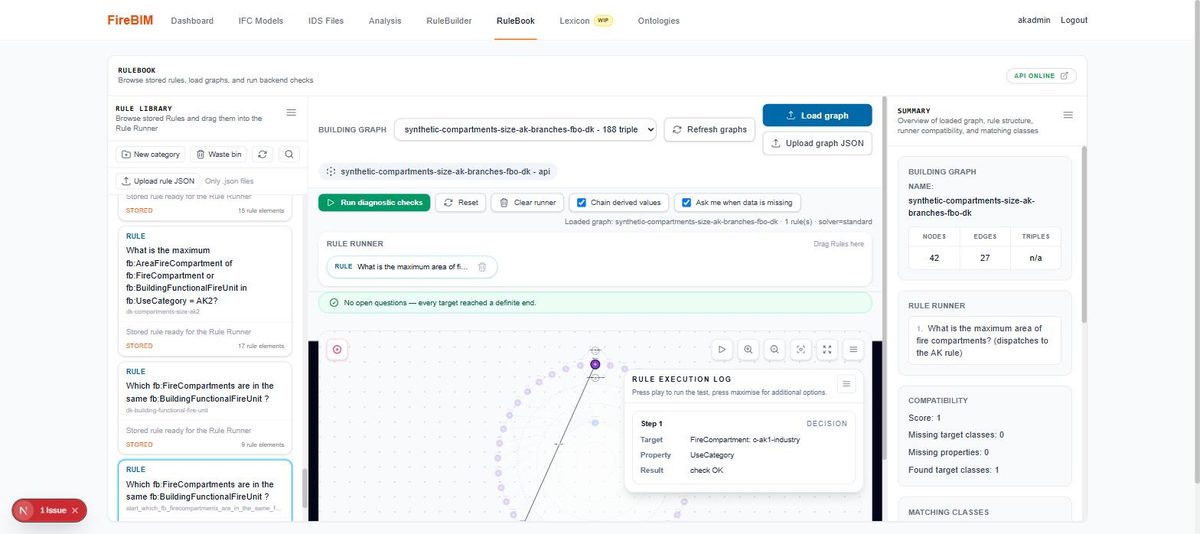
The reference platform shows how the FireBIM building blocks fit together. IFC models are uploaded and converted to a building graph in the FireBIM Building Ontology (FBO, with national extensions); rules are composed visually in the RuleBuilder from start / decision / derive / end elements and compiled to SHACL; the RuleBook runs one or several rules against a graph, chains rules that hand over to each other, shows every decision step and asks the user for the facts the model does not contain. Everything the app does is a call to the public API, so any other front end — or a script — can do the same.
- Availability
- Open source · Free · Login required
- Price
- Free · open source (ITEA4 FireBIM project)
- Countries
- BE · DK · LT · NL · PT (national FBO extensions)
- Standards
- IFC · IDS · RDF / OWL · SHACL · OpenAPI
- Status
- Beta — under active development
Two parts: the API and the web app
FireBIM is API-first. The web app you see is one client of a public REST API — everything it does, you can do from your own tool.
FireBIM API
A FastAPI service that stores building graphs, rules and ontologies, converts IFC, compiles rules to SHACL and runs the checks (four independent runners must agree). Fully described by an OpenAPI schema — every screen of the web app is a documented call.
/graphs· publish and fetch building graphs, write answers into an answered copy/rules· validate, compile, publish, decompile rules and rule elements/checks· run a rule against a graph (standard, horizontal, vertical, blind) with derived values and open questions/ontologies· the FBO registry, versions, sync
FireBIM Webapp
A Next.js front end: IFC models and IDS files, the RuleBuilder canvas, the RuleBook rule runner, the Lexicon and the ontology browser. It keeps no logic of its own — it composes API calls and shows the results, so the same checks can be run from any other client.
- RuleBuilder · compose rules from stored rule elements, save as workspaces
- RuleBook · drop rules into a runner, chain linked rules, answer open questions
- Ontologies · browse FBO core and the national versions
For developers
Build your own front end, plug the checks into a BIM tool, or run the stack yourself. The documentation pages collect the ontology registry, the modelling guideline and the API reference; the source code lives in the FireBIM-org GitHub organisation (partner access during the development phase).
- Ontology registry · FBO core, BE / DK / LT / NL / PT versions, Turtle downloads
- Modelling guideline · what to model in IFC so FireBIM can check it
- Example graphs · synthetic buildings to test rules against
Other FireBIM platforms
Consortium partners build their own products on the FireBIM building blocks — the FBO ontology, the rule formalism, the IFC-to-graph conversion and the IDS / SHACL checks. Some are live demos, some are announced; this list grows as they are released.
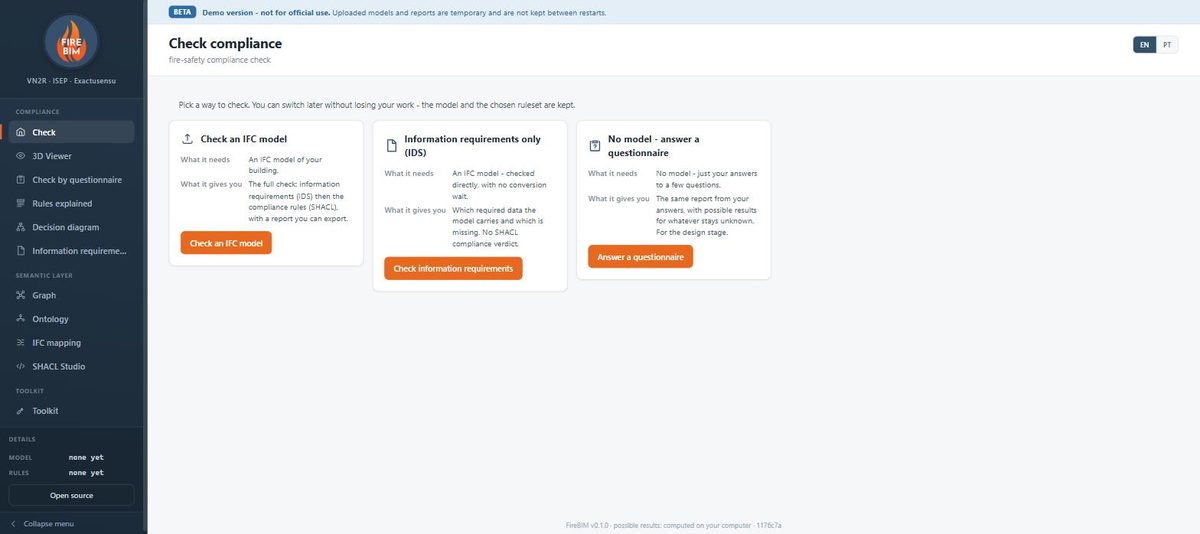
FireBIM – Compliance (VN2R · ISEP · Exactusensu)
A Portuguese fire-safety compliance checker: upload an IFC model, run the information requirements (IDS) and the SHACL rules, and export the report — or answer a questionnaire when there is no model yet.
Built on open-source components (IfcOpenShell, pySHACL, RDFLib, React), the demo offers three ways to check: a full IFC check (IDS first, then the SHACL compliance rules with an exportable report), an information-requirements-only check, and a questionnaire for the design stage. A 3D viewer, a decision diagram and a "rules explained" view sit next to the semantic layer: graph, ontology, IFC mapping and a SHACL Studio. The rules are VN2R's structured reading of the Portuguese SCIE regime and are not a certified legal transposition.
- Availability
- Demo · Free
- Price
- Free demo · not for official use
- Countries
- PT
- Status
- Beta demo (v0.1) — uploads are not kept between restarts
BIM-Connected FireBIM
Screenshot to followDutch consortium partner developing a web-based fire-safety assessment on top of its Wistor platform.
BIM-Connected is a BIM consultancy and software developer that received ITEA4 funding to build a web-based platform harmonising fire-safety codes across countries. Details of the FireBIM offering have not been published yet — follow the link for the announcement and news.
- Availability
- To be announced
- Price
- To be announced
- Countries
- NL
- Status
- In development — no public release yet
D-studio FireBIM
Screenshot to followBelgian consortium partner working on BIM applications for the verification and validation of fire-safety compliance.
D-studio's portfolio page describes the FireBIM ambition — a harmonised, open BIM platform that streamlines fire-safety assessments across European jurisdictions and lets compliance be verified from the early design phases. Product details have not been published yet — follow the link to the portfolio page.
- Availability
- To be announced
- Price
- To be announced
- Countries
- BE
- Status
- In development — no public release yet
Kabandy
Screenshot to followCloud BIM data platform (quantity take-off, model enrichment, IFC / IDS / BCF) — consortium partner; a FireBIM offering is to be announced.
Kabandy is a subscription-based cloud platform that turns BIM models into structured data: visual quantity take-off, AI-assisted classification and enrichment, native Revit and IFC input, IDS and BCF support. How FireBIM checks will surface in Kabandy has not been published yet — follow the link for the product and pricing.
- Availability
- Subscription · To be announced
- Price
- Subscription (see kabandy.com/pricing)
- Countries
- BE · FR · UK
- Status
- FireBIM integration to be announced
Building a FireBIM platform? Send us the link, a screenshot and a short description via the FireBIM consortium and it will be listed here.