
The GENIUS vision for the future of GenAI in software engineering
Generative artificial intelligence (GenAI) is changing the way software is developed. At the same time, its direct implementation still faces considerable uncertainties today in terms of security, data privacy and reliability. This is precisely where the ITEA project GENIUS (Generative AI for the Software Development Life Cycle) takes action. More than 30 industrial and academic partners from Austria, Belgium, Canada, Finland, Germany, Portugal, Türkiye, and the United Kingdom are pooling their expertise to drive this progress forward in a targeted manner and fundamentally transform software development. The aim is to make generative AI usable across all phases of the software development life cycle (SDLC), from requirements definition to maintenance.
The project aims to develop scalable, reliable and industry-proven AI solutions that support software engineers in all steps – through intelligent requirements analysis, architecture-aware code generation, agent-based development workflows, automated testing, continuous quality assurance and advanced documentation assistants. “With GENIUS, we are bringing generative AI to an industrial scale,” says Nicolas Bonnotte, Director of Akkodis Research Germany. “The project shows how AI can be used responsibly, safely and purposefully to increase productivity, relieve skilled workers and strengthen Europe's technological independence.”
Vision paper
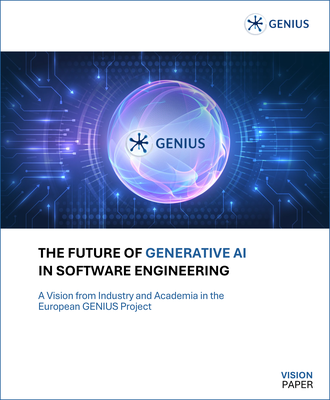
A key outcome of the project is the recently published vision paper “The Future of Generative AI in Software Engineering”. It shows the potential that generative AI can unleash across the entire software development cycle and the technical, organisational and ethical prerequisites that need to be established to achieve this. The paper provides a clear five-year vision for the future of software development, describes new role models for developers and outlines technological and methodological advances that enable the use of trustworthy AI in practice. “New generative AI technologies and communication with systems in natural language open up completely new possibilities for connecting software development processes across all phases and making them more efficient,” says Robin Gröpler, Research Associate at ifak and GENIUS Project leader. “We are in a phase of profound change in which generative artificial intelligence is not only expanding tools, but also redesigning entire development processes. The close cooperation of numerous international partners in GENIUS enables innovations in how humans and AI can jointly develop software in the future – for efficient, sustainable and competitive solutions.”
With its cross-industry approach, GENIUS strengthens Europe's technological sovereignty and innovative power in the field of trustworthy AI and paves the way for a new generation of intelligent, responsible software development.
The work was published as a conference paper and presented at the 2nd IEEE/ACM International Conference on AI-powered Software (AIware 2025) on 20 November 2025 in Seoul, South Korea. In addition, a dedicated white-paper edition has been prepared for broader audiences. It is publicly available on the GENIUS project website: https://genius-itea.github.io/pubs/#vision-paper
More information: https://itea4.org/project/genius.html and https://genius-itea.github.io/